Vehicle Wraps and Graphics in London, Ontario: Mobile Marketing That Works
London’s streets tell their own story. Watch the morning flow down Wonderland Road, the steady hum along Fanshawe Park Road, the construction roundabouts near Hyde Park, and the campus curls around Western University. You will notice it fast once you start looking: the brands that own the road are not just on billboards. They are on the vehicles right beside you at the light. Smart companies in the Forest City treat their vans, pickups, box trucks, and even compact cars as traveling storefronts. When done well, vehicle wraps and graphics turn every errand and job site into a small ad campaign that builds frequency without feeling like an ad at all.
I have spent years around the practical side of wraps in Southwestern Ontario. In that time, I have seen the difference between a crisp design that pulls calls and a cluttered wrap that blends into slush-gray winter. I have also seen what our winters do to cheap vinyl, and what a disciplined installation looks like six Februaries later. If you are considering a wrap in London, this guide will help you make decisions that hold up under daily use and still look fresh when you drive through your thousandth salt bath.
Why wraps work on London roads
The numbers are not hard to understand. A vehicle in a mid-sized Canadian city can rack up tens of thousands of local impressions each month, more if it runs daily service routes or sits in visible parking lots. A single wrapped van parked near Oxford and Richmond can be seen by the same pedestrians and commuters again and again, which builds recognition at a cost per thousand impressions far below most paid channels. When you factor in the life of a quality wrap, usually four to six years in our climate for cast vinyl that is laminated, the math compares favorably to digital ads, radio, and most print buys.
It is not only about impression count. Repetition on familiar routes creates mental shortcuts. People do not memorize phone numbers from moving vehicles, but they do recall a simple brand name or a distinctive shape when they need a plumber at 10 pm. I often advise clients to picture their vehicle in February at 5 pm on Wellington when everything feels gray. If your brand cues still read at a glance in that light and slush, you will get calls in July too.
What a wrap is, and what it is not
A full wrap dresses nearly every painted surface in printed cast vinyl, often with conformable films from brands like 3M, Avery Dennison, or Orafol. A partial wrap uses large panels on the sides and rear while leaving parts of the original paint visible. Simple cut-vinyl graphics apply spot color logos and text without a printed image. All three have a place.
Quality wraps use a cast film with a matched laminate, which protects the print from abrasion and UV fade. Cast vinyl starts its life in a liquid state, which makes it dimensionally stable and willing to conform to complex curves, door handles, and corrugations. Cheaper calendared films are made differently and want to shrink back toward their original shape. They cost less, but they pull at edges and fail faster in heat and cold cycles. Our winters amplify the difference. A wrap that looks great leaving a warm shop can reveal its true nature after its first freeze-thaw.
A wrap is not armor. It resists minor scuffs and protects paint from UV, but it is not a miracle shield. Parking lot rash, rock chips on the hood, and careless gas pump scrapes can mark any film. If a shop promises invincibility, take a breath and ask to see a three-year-old vehicle they wrapped that still looks good. The best installers are proud to show aging work.

The London factor: roads, weather, and bylaw realities
London gets hot sun in July and brine in January. That means smart choices and a bit of care. It also means knowing the limits of what you can legally cover.
Winter and road salt. Salt and brine creep under lifted edges, then freeze and thaw. Quality films with properly sealed edges handle this well, but even the best material fails if the panel edges were stretched too hard during install or if the surface was not prepped. Wheel wells, rocker panels, and leading edges of hoods and box truck fronts take the most abuse. Some clients choose paint protection film on the nose and a printed wrap further back on the body. It adds cost, but it is cheaper than reprinting a nose panel every second winter.
Sun and fade. Printed wraps last longer with a laminate rated for UV exposure. Even then, south-facing parking accelerates fade. A garage or even a regular carport extends life. Think of it as sunscreen for your brand.
Windows and sightlines. Ontario’s Highway Traffic Act prohibits obstructing the driver’s view. That is common sense, but it has specific implications for wraps. Solid vinyl cannot go on windshields or front side windows. Perforated window film can be used on rear side windows and the back window for many vehicles. It looks solid from the outside and allows occupants to see out through the tiny holes. If the rear window is covered, ensure you have functional side mirrors and that wiper or defroster function is not compromised. A reputable shop will design and install with visibility and safety in mind.
Local branding context. Londoners spend time on arterial roads at moderate speeds, often 40 to 70 km/h. That changes how a wrap should read. Decorative micro-patterns and small text do not earn their keep. Clean contrast, simple hierarchy, and big type do.
Design that earns attention without trying too hard
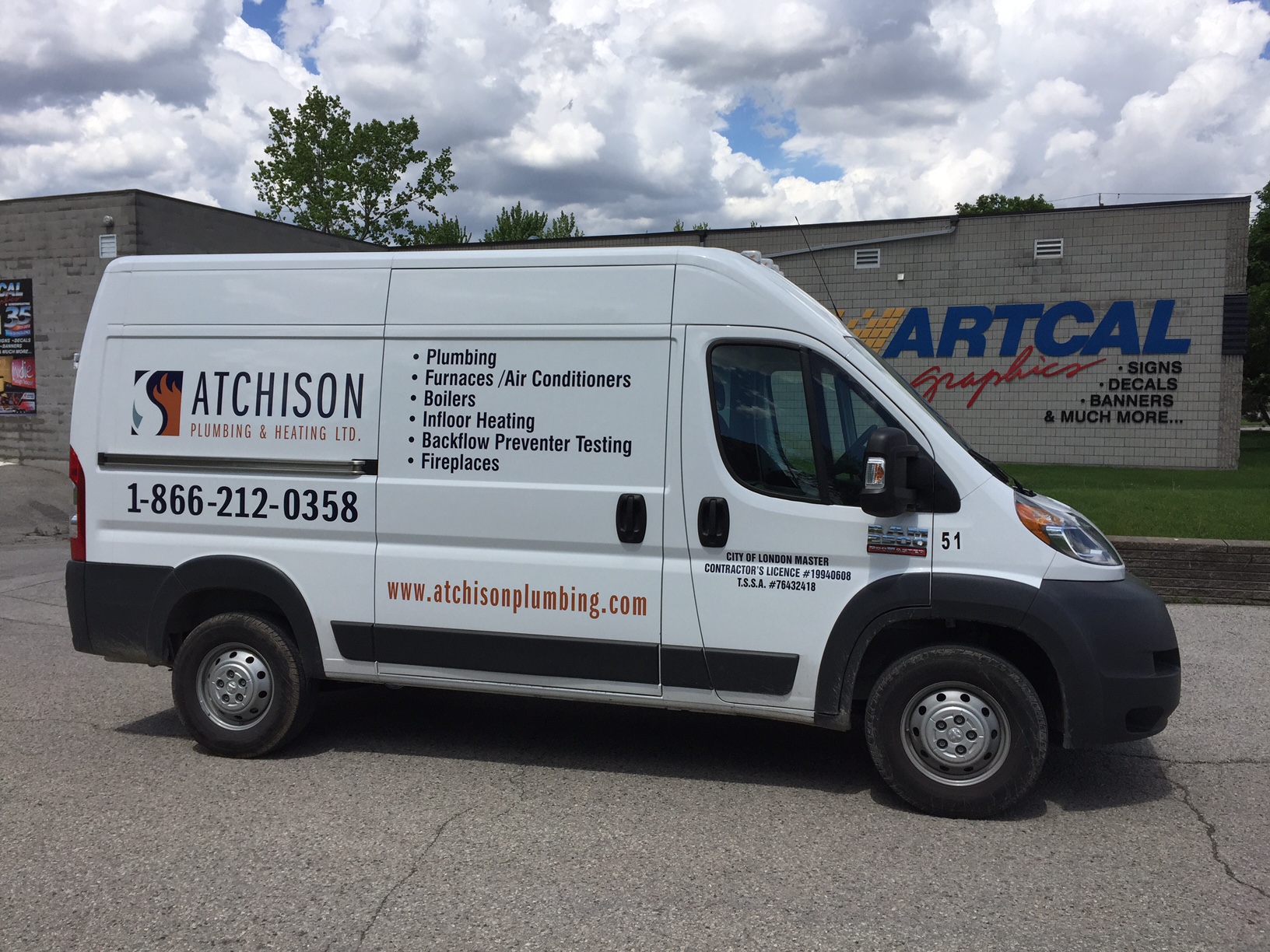
The most effective wraps in London have three things in common: you can spot the brand from 30 paces, you can tell what they do in three seconds, and you know how to contact them without squinting. Everything else is optional.
Hierarchy. Anchor the design with a clear brand mark or name. Support it with a short descriptor. If your name is not self-explanatory, say what you do using the simplest words possible. One trade client saw a 20 percent lift in tracked calls after changing from a clever tagline to “Emergency Plumbing and Drain.” It was not poetry, but it paid the bill.
Colour and contrast. London’s winter light is blue and low. The road spray is brown. Choose colours that punch through the gray. High-contrast palettes and solid fields work better than photo-heavy backgrounds with subtle gradients. When we wrapped a coffee truck in matte black with oversized yellow block letters, it grabbed attention even in a snowstorm. The photo menu moved to a QR code by the order window where people had time.
Contact method. You rarely need a phone number and a URL and social handles and a QR code. Decide which one converts fastest for your audience. For emergency services and trades, a giant phone number still wins. For boutique services and B2B, a simple URL does the job and is easier to remember. If you use QR, ensure the code sits flat on a door or rear panel, not over a handle or seam.
Fleet consistency. For companies with multiple vehicles, keep the language and brand colours identical while allowing small model-specific tweaks. A Ford Transit and a Ram ProMaster do not have the same panel geometry. You get better results letting your designer tune each layout rather than forcing a one-size-fits-all grid.
Restraint. The best wrap design almost always removes more elements than it adds. If your designer cannot let go of nine service icons and a full-bleed photo plus a tagline and a special offer, ask to see two versions: one with everything, and one with only a logo, a five-word service promise, and a contact method. Put both in front of someone who is not in marketing and ask which they would remember at a red light.
Materials, print, and what quality really means
Good materials and printing are not buzzwords. They are the difference between a wrap that pays for itself and one that hurts your brand after two winters.
Film. For contoured vehicles, use a premium cast film with air-release adhesive that allows repositioning. Heavier-duty films exist for textured surfaces, but for most vans, trucks, and cars, a conformable cast film is ideal. Calendared films can be useful for flat trailers or very short-term promotions, but do not expect them to last or to behave around deep curves.
Laminate. A matched cast laminate at the correct thickness protects the ink from UV and abrasion. Gloss gives a painted look and better colour pop. Matte mutes reflections and hides slight panel imperfections. Satin sits between. Many London fleets choose gloss for visibility, matte for a premium feel on boutique or creative brands.
Ink and printing. Solvent, eco-solvent, latex, and UV printers all have a place. The point is not the brand of printer, it is colour management, curing time, and handling. Prints need time to outgas before laminating or you risk trapped solvents causing bubbles weeks later. A shop that rushes from print to laminate to install in the same day is gambling with your result.
Edges. The quiet craftsmanship in a wrap lives at the edges and seams. Properly relieved door handle cups, post-heat on stretched areas to lock shape memory, and sealed edges where road spray hits hardest. You can spot a careful installer by how they talk about these details and by the way they ask for your vehicle overnight so the film can sit in a heated bay after application.
What an installation actually looks like
Most owners never see the prep, only the finished vehicle. The prep makes the finish. Expect the shop to book your vehicle for one to three days depending on complexity and whether panels need removal. Mirrors, lights, and door handles sometimes come off for a cleaner wrap and better longevity. That takes time but saves edges.
The bay should be clean, well lit, and warm. Around 18 - 24 degrees Celsius is comfortable for vinyl and for installers alike. The vehicle is washed, then wiped with isopropyl alcohol to remove wax, silicones, and road film. Surface imperfections such as chips or rust are discussed. Vinyl does not stick well to failing paint. If the paint peels when masking tape lifts, a reputable shop will warn you and recommend paint work before wrapping.
Here is a simple owner-side checklist that helps an install go smoothly.
- Remove personal items from the vehicle, including toolboxes and shelving where possible.
- Provide the vehicle clean and dry, or budget for a full prep wash at the shop.
- Mention any aftermarket parts, body repairs, or repainted areas that might affect adhesion.
- Plan to leave the vehicle overnight so the film can acclimate and adhesives can settle.
- Confirm access to keys, alarm codes, and parking for drop-off and pick-up.
On install day, installers align panels to hide seams where possible and to keep visual elements square to body lines. After application, they heat-stabilize stretched areas and roll edges. A final inspection catches bubbles or lifted corners. A good shop will ask you back after a week for a quick look once the film has settled, especially in winter.
Costs, ROI, and what the budget should really buy
Prices vary by vehicle size, coverage, https://www.facebook.com/ArtcalGraphics film type, and the amount of bodywork or disassembly required. For London, here is a realistic snapshot based on common projects and quality materials.
- Spot graphics on doors and rear: often 450 - 1,200, depending on size and layers.
- Partial wrap on a service van: commonly 1,800 - 3,500 for sides and rear.
- Full wrap on a standard cargo van or SUV: often 3,500 - 6,500.
- Box truck sides and rear with printed panels: 2,800 - 6,000, size dependent.
- Fleet projects: per-vehicle costs drop with volume once design and colour are locked.
These numbers assume cast film and laminate, professional installation, and standard prep. If a quote comes in dramatically lower, ask what film is being used, whether lamination is included, and how long prints cure before lamination. Savings today can become a reprint in two winters.
Tracking ROI helps justify the spend. Use a unique phone extension on the wrap or a dedicated URL. One heating company we worked with added a short code on the rear of their trucks and asked new callers how they heard about them. Over six months, they traced roughly a quarter of inbound service calls to the vehicles, with the bulk coming from parked visibility at big retail lots and job sites.
Caring for a wrap in a four-season city
A little care goes a long way. Hand washing or touchless wash cycles are best. If you use an automatic wash, avoid stiff brushes that can lift edges. High-pressure wands should be kept a safe distance from seams. In winter, rinsing off brine helps. For stubborn grime, a gentle all-purpose cleaner followed by an isopropyl alcohol wipe on tough spots works well. Avoid harsh solvents, gasoline drips, or scraping ice with blades against wrapped areas.
Sun exposure fades everything eventually. If you park outside at work, try for shade at home. Consider a simple ceramic coating made for vinyl to ease cleaning and add a layer of UV resistance. It will not stop fade, but it will slow it and make spring washes less of a chore.
If a panel is damaged, most wraps can be repaired by replacing a single section rather than the whole vehicle. Keep your print files and colour profiles on hand with your provider so the reprint matches. Over time, the original may have faded slightly, so the installer may recommend replacing both side panels to keep the look consistent.
Regulations, insurance, and practicalities
Insurance companies in Ontario generally treat wraps as a customization, not a structural modification. Let your insurer know the replacement value of the wrap. If the vehicle is in an accident, you will want coverage for reprinting and reinstalling panels on the repaired area.
Parking and bylaw issues in London are straightforward for vehicles as long as they are legally parked and the wrap does not include prohibited content. Unlike stationary signs, vehicle graphics are not governed by sign permits if the vehicle is used as a vehicle, not a parked billboard. Use common sense. If a business parks a wrapped trailer on a boulevard indefinitely to act as a sign, you can expect questions from bylaw officers. When in doubt, ask your provider. They live in this gray zone and can share what has worked.
For window films, stay clear of the front windows and windshield. Rear and back-side windows can often accept perforated film, but keep safety features functional. A professional shop in London will know the local standards and design around them.
Integrating your wrap with the rest of your brand
A wrap should not stand alone. When it is part of a broader visual system, everything looks intentional. Many wrap providers in the city also handle printing services London Ontario businesses need for day-to-day marketing. Linking your vehicle graphics London Ontario wide with your stationery, yard signs, and job site banners saves time and builds brand recognition. If you are already working with a firm for signs London Ontario companies rely on for storefront visibility, ask them to extend your sign design logic to your vehicles. The fonts, colours, and line weights that read across a parking lot can be tuned to read from two lanes over.
Clothing and promotional gear matter too. It is a small but noticeable win when the technician who steps out of a wrapped van wears apparel that matches the vehicle. Many shops that specialize in screen printing London Ontario businesses use for uniforms can colour match to your wrap inks. When a crew arrives on site and everything matches, from van to hard hats to yard sign, customers assume competence before the first tool comes out.
Real examples from the road
Trades fleet uplift. A local HVAC contractor started small with two partial wraps on mid-roof cargo vans. The design used a large brand mark, blue and white geometric panels, and a single line that read Heating and Cooling 24 - 7. After six months, their call tracking showed roughly 18 - 22 percent of new service calls mentioned the vans. They then wrapped the rest of the fleet, insisting on the same panel layout across different models. The only change was the angle of one geometric line to suit a different door seam. Consistency paid off. People recognized them at a glance.
Food truck launch. A café pivoted into mobile service with a used step van. We planned for the queue side. The big brand hit the opposite side and rear for traffic, but the service side focused on menu readability at standing distance. They used perforated film on the service window to soften glare inside. The wrap cost about what two months of digital ad spend would have, but it performed daily while parked at festivals, craft breweries, and downtown events. The owner joked that the wrap was the only ad they had that got compliments.
Professional services surprise. A small mortgage broker wrapped a compact hatchback with a clean white field, a large name, and a URL. They parked near new housing developments on evenings and weekends. It was a gentle approach, not a shout. Over a season, they picked up several clients who recognized the brand from repeated sightings. Not all wraps need to scream.
Choosing a provider you will still like three winters from now
Talk to at least two shops. Ask to see work that has aged outside for a few years. Check edges, door cups, and high-impact areas. Ask what film and laminate they recommend for your vehicle and why. Listen for discussion about proper print curing, panel relief cuts, post-heating, and aftercare. Those details are where your money is earned.
Balance price with proof. A tight budget is real, but the cheapest quote rarely pencils out after a London winter. A provider offering end-to-end service for graphics London Ontario businesses use across vehicles, storefronts, and print collateral can simplify your life. You make one design decision, then deploy it consistently on trucks, site signs, and brochures. Many of the better print houses in town have grown from signs London Ontario customers needed on day one into full printing services London Ontario teams rely on for everything. That breadth matters when you want your wrap to match your trade show booth without swapping Pantones.
Finally, plan your timeline. Spring and early summer book fast. If you want a fleet ready for back-to-school or the fall rush, start design conversations in late spring. Good installs take time, and you do not want your project squeezed between rush jobs when temperatures bounce between cold mornings and hot afternoons.
The wrap as a long-term asset
A vehicle wrap is a tool you use daily, not a one-off campaign. It wears in public and in weather. If it does its job, it becomes part of how people in London recognize you. The practical steps are not glamorous. Choose proven materials. Keep the design simple. Install carefully. Wash it reasonably. Repair what gets damaged. Tie it into the rest of your brand, from your storefront signs to your uniforms. Do those things, and your vehicle will work while it drives, while it parks, and while it sits at the curb outside a customer’s house. It will do its quiet work through snow squalls on Fanshawe and heat shimmers on Wharncliffe. It will be the ad that never pauses, and over four to six years, it will more than earn its keep.
Artcal Graphics & Printing — Business Info (NAP)
Name: Artcal Graphics & PrintingAddress: 779 Industrial Rd, London, ON N5V 3N5
Phone: +1519-453-6010
Website: https://www.artcal.com/
Hours:
Monday: 8:00 AM – 4:30 PM
Tuesday: 8:00 AM – 4:30 PM
Wednesday: 8:00 AM – 4:30 PM
Thursday: 8:00 AM – 4:30 PM
Friday: 8:00 AM – 4:30 PM
Saturday: Closed
Sunday: Closed
Open-location code (Plus Code): 2RGM+3R London, Ontario
Map/listing URL: https://www.google.com/maps/place/Artcal+Graphics+%26+Printing+Inc/@43.025226,-81.1680305,17z/data=!3m1!4b1!4m6!3m5!1s0x882eed2ae63a528d:0xc7068af2d391a354!8m2!3d43.025226!4d-81.1654556!16s%2Fg%2F1vm7c2pl?entry=ttu&g_ep=EgoyMDI2MDYwMS4wIKXMDSoASAFQAw%3D%3D
Embed iframe:
Socials (canonical https URLs):
Facebook: https://www.facebook.com/ArtcalGraphics
LinkedIn: https://www.linkedin.com/company/artcal-graphics-&-screenprinting-inc./
Instagram: https://www.instagram.com/artcalgraphics/
https://www.artcal.com/
Artcal Graphics & Printing provides signage and graphic design services for businesses and organizations in London, Ontario and surrounding areas.
If you need custom signs, printed graphics, or design support for marketing materials, the team can help you plan the right format and finish for your project.
Common requests include business signage, interior and exterior graphics, vehicle or window graphics, and printed items used for promotions and day-to-day operations.
Artcal Graphics & Printing serves London and nearby communities throughout Southwestern Ontario.
Hours listed are Monday–Friday 8:00 AM–4:30 PM, with Saturday and Sunday closed.
For directions and listing details, use the map listing: https://maps.app.goo.gl/A2EZfwDigfcN14zA8
To request pricing or share artwork details, call +1-519-453-6010 or use the contact options on https://www.artcal.com/.
Popular Questions About Artcal Graphics & Printing
What types of signage can a sign shop produce?Many sign shops handle items like storefront signs, window graphics, decals, banners, and other custom displays (options depend on materials and project needs).
Do I need a print-ready file to place an order?
Not always—some shops can help with design or preparing artwork, but it’s best to confirm file formats, sizing, and resolution requirements before production.
How long does a signage or print project take?
Turnaround varies based on the product type, quantity, and production schedule. Sharing your deadline early helps confirm timing.
What are the hours for Artcal Graphics & Printing?
Hours listed: Monday–Friday 8:00 AM–4:30 PM; Saturday closed; Sunday closed.
How can I contact Artcal Graphics & Printing?
Phone: +1-519-453-6010
Website: https://www.artcal.com/
Map: https://maps.app.goo.gl/A2EZfwDigfcN14zA8
Landmarks Near London, ON
1) Victoria Park2) Covent Garden Market
3) Budweiser Gardens
4) Western University
5) Fanshawe College
6) Springbank Park